SEO vs. AI Search: What Actually Changes (and Why Your SEO Skills Aren't Wasted)
SEO ranks your page as a link. AI search cites you, or doesn't, inside an answer someone else generates. That shift changes the unit you're optimizing.

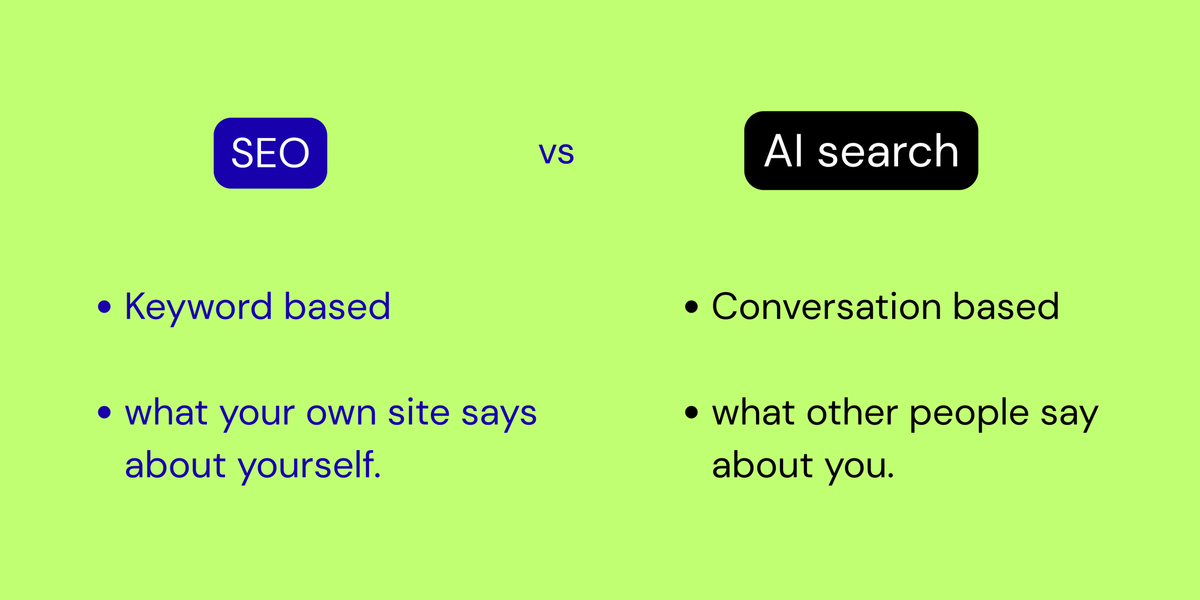
You probably already have a working model of SEO. What's less obvious is where that model stops applying once you're dealing with AI search and where it still holds.
The short version: SEO ranks your page as a link. AI search cites you, or doesn't, inside an answer someone else generates. That shift changes the unit you're optimizing. This post breaks down where SEO and AI search overlap, where they diverge, and how to prioritize your effort across ChatGPT, Gemini, and Perplexity.
One terminology note before we start: you'll see this discipline called GEO (Generative Engine Optimization), AEO (Answer Engine Optimization), or "AI SEO" more or less interchangeably. They're not a formally standardized taxonomy :different vendors and writers use them slightly differently, so don't over-invest in picking the "correct" term. .
The basics
What is SEO?
SEO is the practice of improving a website so it ranks higher in search engine results for relevant queries, with the goal of driving organic traffic. It's still mostly a Google conversation, and ranking higher still means more clicks. Three areas make it up:
- Technical SEO: making sure search engines can crawl, render, and index your site (site speed, mobile-friendliness, site structure, sitemaps).
- On-websiteSEO: optimizing individual pages — keywords, title tags, headers, meta descriptions, internal linking, content quality.
- Off-website SEO: building authority and trust signals from outside your site, mostly through backlinks from other reputable domains.
What is AI search?
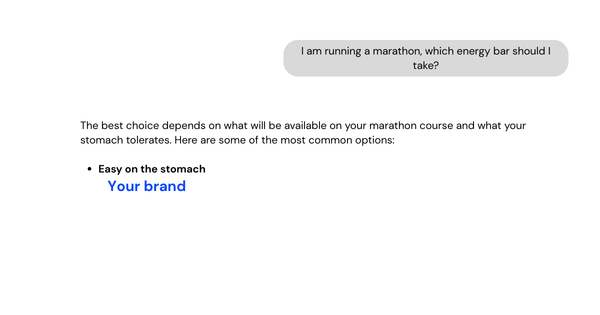
AI search is what happens when someone asks a question to ChatGPT, Gemini, Perplexity, or Google's AI Overviews, and the system generates a direct answer often naming specific sources, brands, or products inside it instead of returning a list of links to evaluate yourself.
AI search splits into two mechanically different setups:
- Retrieval-augmented answers (Google AI Overviews, Gemini, Perplexity, ChatGPT search): the system runs a query against a search index first, pulls back a candidate set of pages or passages, and then uses an LLM to read that set and synthesize an answer, citing whichever sources it judged most relevant and credible. This is the pattern most GEO advice is actually about.
- Answers from parametric memory: the model answers from what it learned during training, with no live retrieval step. This is closer to how a person recalls a fact than to search. You have essentially no ability to influence this in real time, the only lever is whether your content was prominent and credible enough in whatever got scraped for the model's training data, months or years before the answer is generated.
Most of what people mean by "getting cited in AI search" is the first pattern. That's the one worth optimizing for, because it has a retrieval step you can actually influence.
How does AI search work compared to SEO?
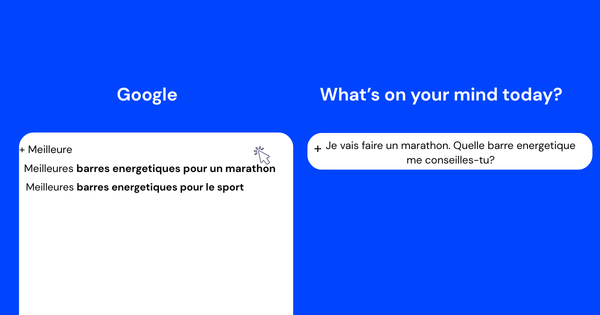
Classic SEO was keyword matching: the words in the query needed to overlap with the words on your page. Google has since moved to semantic and entity matching, so it understands meaning rather than just strings but the structural logic hasn't changed. It's still your page, as a single unit, competing to be the best match for a query, ranked and returned as a link.
AI search works differently at each stage:
1. Retrieval isn't page-level, it's passage-level. When an engine retrieves candidates for a query, it's typically not fetching "your page" as a whole, it's matching against chunks or passages of content. A page can be well-ranked in Google and still fail here if the specific answer-bearing paragraph is buried, vague, or spread across multiple sections.
2. Synthesis, not ranking, decides what gets cited. Once the engine has a candidate set, an LLM reads across sources and decides what's worth including and attributing. That decision leans heavily on how many independent sources say the same thing, and how credible those sources seem which is why AI search depends so much more on third-party corroboration (reviews, comparisons, forum mentions, other people's articles) than on your own site's optimization. You can be exactly right and still get skipped if you're the only source saying it.
3. Crawlability requirements are stricter, not looser. Google has spent two decades getting good at rendering JavaScript. Most AI crawlers have not, a lot of them still read raw HTML. Content that's genuinely present on the page but only rendered client-side (behind a JS-driven accordion, tab, or infinite-scroll component, for instance) can rank fine in Google while being functionally invisible to an AI engine that never executes the script. If you've done technical SEO work, this is the check worth re-running specifically for AI crawlers, not just Googlebot.
4. There isn't one crawler, there are several, doing different jobs. Most AI companies now run a layered crawler setup: training crawlers (e.g. GPTBot, ClaudeBot) that scrape in bulk to improve future model versions and aren't tied to any single query; indexing/retrieval crawlers (e.g. OAI-SearchBot, PerplexityBot) that build the index an assistant actually searches at answer time; and on-demand fetchers (e.g. ChatGPT-User, Claude-User, Perplexity-User) that pull a live page the moment a real user's question needs it. This matters practically: blocking a training crawler is mostly a data-licensing decision with little effect on whether you show up in answers today, but blocking a retrieval or on-demand crawler can remove you from active citations even if your content was already scraped in the past. If you're going to touch robots.txt for AI bots, know which tier you're allowing or blocking.
5. llms.txt is not a shortcut, despite the hype. You'll see recommendations to add an llms.txt file (a plain-text manifest pointing models to your key pages) as an AI-visibility play. As of mid-2026, no major consumer AI search product not Google, not ChatGPT, not Perplexity, not Gemini has confirmed it's used as a citation or ranking signal, and independent crawl-log studies show retrieval and search bots almost never fetch it. Google has said explicitly it isn't used for Search or AI Overviews. It's essentially free to ship and may matter more for agentic/dev tooling down the line, but don't treat it as a lever for citation visibility today that budget is better spent on third-party mentions.
SEO vs. AI search
| SEO (Google Search) | AI Search (AEO/GEO) | |
|---|---|---|
| Core mechanism | Semantic + entity matching ranks your page as a link | Retrieval pulls candidate passages, then an LLM synthesizes and cites |
| Unit of optimization | The page (content, structure, on-page signals) | The passage/claim, and the brand as an entity across the whole web |
| What "winning" looks like | Ranking high enough to earn a click | Being cited or recommended inside the generated answer |
| Where signals come from | Mostly your own site plus backlinks pointing to it | Heavily weighted toward third-party mentions, reviews, and citations not on your site |
| Crawl requirements | Tolerant of JS-rendered content; Googlebot renders pages | Many AI crawlers read raw HTML only; JS-hidden content can be invisible |
| User's next step | Clicks through to your site to find the answer | Gets the answer directly — no click required |
What to do if you're already strong at SEO
A friend who'd conquered a meaningful chunk of his category's keywords was genuinely thrown to find AI engines weren't citing his brand. I get it, if you've spent years building SEO muscle, you already have the hardest part done: you know how to think about search intent, structure content around it, and earn backlinks that hold up.
AI search asks a different question than SEO does. SEO asks "is my page the best answer?" AI search asks "am I part of the answer at all?"
So the job shifts from perfecting your own site to making sure the rest of the internet says accurate, citable things about you: reviews, comparisons, mentions inside other people's content, the third-party sources an AI engine is actually pulling from when it retrieves candidates for a query. Technical SEO and on-page work aren't wasted; they're necessary but no longer sufficient, and they only cover one input into a much larger system.
The right strategy depends on your industry (ecommerce, B2B SaaS, manufacturer), but the first step is consistent across all of them: prompt-content alignment figuring out what your prospects are actually asking AI, and building content and third-party presence around those specific prompts, not your existing keyword list.
FAQ
Does AI search replace SEO? No. Google is still where most people search, and semantic SEO still determines whether your page ranks there. AI search is a parallel channel with a different retrieval mechanism, you need both, and they're won differently.
Do I need backlinks for AI search the same way I do for SEO? Not exactly. Backlinks are a Google trust signal for your site's authority. AI search cares more about whether independent sources, reviews, articles, forums, other brands. mention you at all, and whether multiple sources agree, regardless of whether they link back.
Is AI search the same across ChatGPT, Gemini, and Perplexity? No. Each has a different retrieval index and different training data, so the same brand can surface in one engine's answers and not another's. Treat "AI search visibility" as several separate targets, not one.
Can I rank in AI search without ranking in Google first? In principle, yes engines like Perplexity and ChatGPT run their own retrieval and aren't limited to top Google results. In practice, established traditional-search visibility makes you easier to find and cite in the first place, so the two reinforce each other.
What matters most for AI search visibility? Being talked about accurately and consistently by other people and sites — third-party mentions, reviews, and citations matter more here than optimizing your own page ever did for classic SEO. Technical crawlability (can the relevant AI bots actually read your content) is the close second most people skip.